
Rail Vehicle Engineer. Training course
Organized by CIFI | Italian College of Railway Engineers
28 hours.
Live . Multilingual Accessibility
from January 15th , 2025
Customized course editions
Italian College of Railway Engineers – CIFI
The Rail Vehicle Engineer course is organized by the Italian College of Railway Engineers (CIFI), founded in 1899
The is one of the oldest and most important technical and professional associations in Italy. Its main objectives are:
- To promote the study of scientific, technical, economic, and legislative issues related to land transport.
- To propose the best solutions to these issues, engaging with public opinion, the Executive and Legislative Powers of the State, public Administrations and private entities.
- To enhance the role of engineers and transport experts and contribute to their cultural advancement.
- To contribute to the improvement of technical culture and the professional training and development of those working in the land transport industry.
The College, which brings together around 2,400 individual members involved in land transport, has always been chaired by eminent figures in the field of transport science and technology. According to the new statute, both engineers as ordinary members and non-engineers as associate members can register as individual members. Additionally, engineering students can register as junior members. The College also includes over 150 industrial and transport companies, several university institutes, Public Companies and departments and engineering orders as collective members
Rail Vehicle Engineer


Rail Vehicle Engineer – Course Objectives
The objective of the “Rail Vehicle Engineer” course is to provide participants with comprehensive knowledge on the regulatory framework, design, procurement, operation, and maintenance of railway vehicles.
It equips engineers with the necessary skills to manage the lifecycle of railway rolling stock, including dynamic vehicle behavior, interoperability standards, and the use of maintenance machines.
The course also addresses safety issues through on-board subsystems and prepares participants to meet certification and regulatory requirements in the railway sector, ensuring effective and efficient operations.
The course objectives also include explaining: rail vehicle maintenance, rail vehicle design, rail road vehicle, rail vehicle replacement program, hi-rail vehicle, etc.

TOPICS
Provide knowledge on the regulatory framework for railway vehicles

understand the possible operation uses of rolling stock

describe the design process of a railway vehicle, from the concept design to the management of obsolescence

Know the responsibilities in the design, procurement, construction, commissioning, operation, and maintenance phases

Provide adequate knowledge on the machines used for the construction and maintenance of railway tracks

address the issues of safety in the operation phase through the use of on-board subsystems

The program of the course is designed for those who want to implement their skills in the various areas of rolling stock and railway vehicles in general.
It is aimed at those who work or intend to work in the field of design and construction of railway vehicles in which different types of engineers are interested, each with a specific specialization:
- Mechanical engineers or experts: They deal with the design and development of mechanical components of the train, such as the chassis, wheels, suspension and braking systems.
- Electrical engineers: they design and develop the electrical systems of trains, which include power supply, traction, lighting, air conditioning, and electronic control systems.
- Electronic engineers: They work on electronic components and systems, such as control and automation systems, on-board communication and signalling systems, and on-board diagnostics.
- Systems Engineers: They focus on the integration of all the subsystems of the train, ensuring that they work together harmoniously and effectively. They also manage the interoperability of the systems and the adaptation to different environments and operating conditions.
- Rolling Stock Engineers: They are specialised in the design and maintenance of locomotives, passenger cars, freight cars and locomotives.
- Aerodynamic Engineers: They play a key role in the design of vehicles to reduce aerodynamic drag and improve energy efficiency.
- Environmental Engineers: They ensure that the design and manufacture of vehicles is done in accordance with sustainability principles and minimises environmental impact, for example through efficient use of energy and reduction of emissions.
- Structural Engineers: They focus on the structural design of trains, ensuring the strength and safety of structures under different loading and stress conditions.
- Computer Engineers: They develop software and computer systems for train control, on-board information management and communication with trackside signalling systems.
- Acoustic Engineers: They work to reduce internal and external noise produced by trains, improving passenger comfort and reducing the acoustic impact on the environment.
Rail Vehicle Engineer
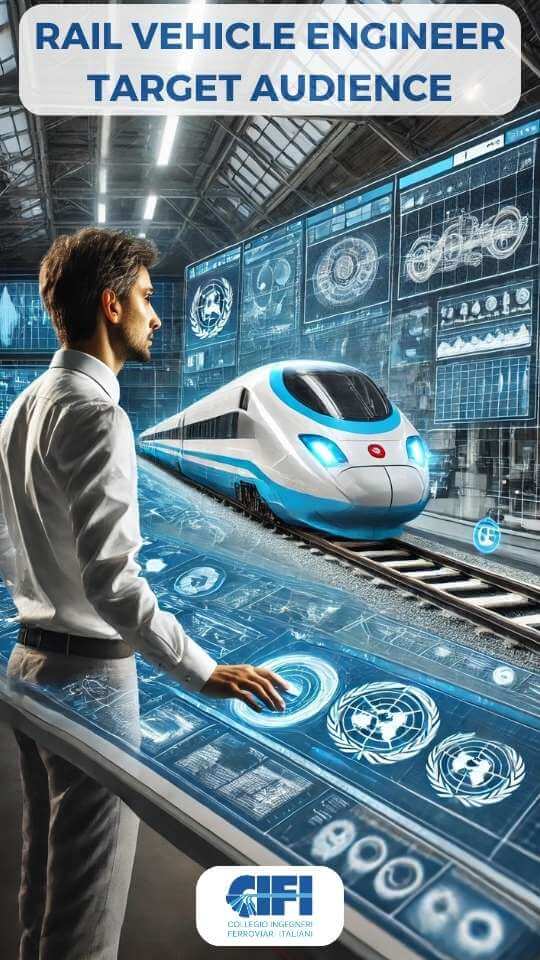
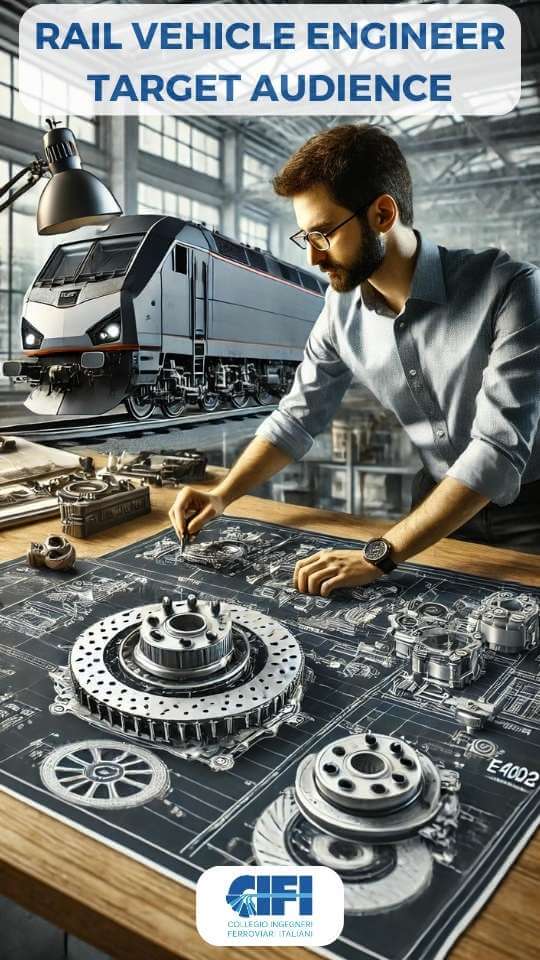
Briefly, the design and construction of railway vehicles require close collaboration between different engineering disciplines, each of them is crucial and requires skills to ensure that trains are safe, efficient, comfortable and sustainable.
There are still numerous professional figures who, dealing with technical standardisation of vehicles or compliance verification, may be interested in the contents of this course. For example:
- Railway Safety Regulation Specialists: they develop and update specific safety standards for the railway sector, focusing on safety management systems, risk assessment methods, accident prevention, etc.
- Interoperability Experts: They work on defining standards that ensure the interoperability of railway systems between different countries or regions, facilitating cross-border traffic and improving the efficiency of the railway system.
- Electrical and Mechanical Engineers for Technical Standards: They define technical standards for the electrical and mechanical systems of trains, ensuring safety, reliability and performance.
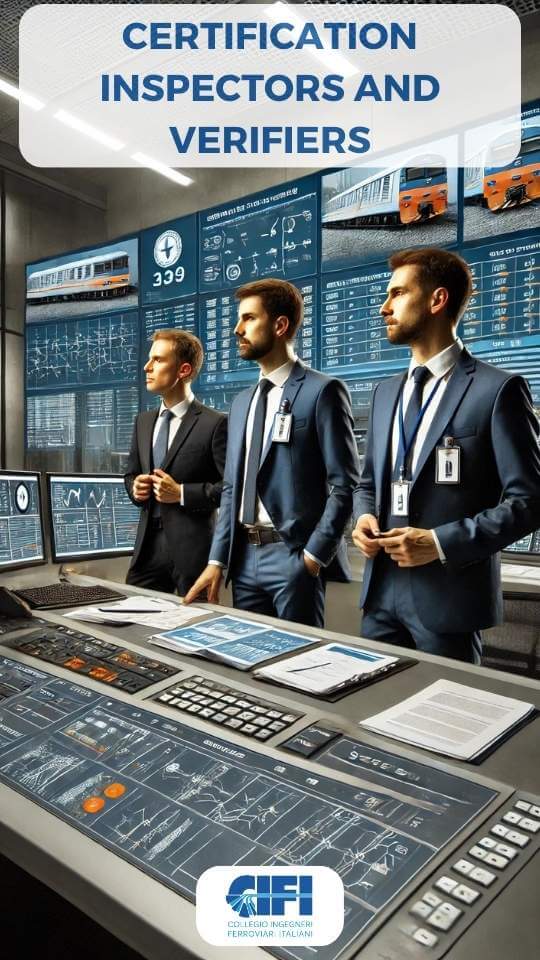
- Certification Inspectors and Verifiers: They check and verify that trains and their components meet all the required standards and certifications. They often work in certification bodies or as external consultants.
Those responsible for managing rolling stock fleets:
- Planning and Coordination: Organise and coordinate, on behalf of the railway undertaking, the movement of trains on the railway network. This includes planning timetables, managing paths, resolving scheduling conflicts, etc.
- Maintenance: Ensure that railway vehicles are maintained in accordance with their Safety Management System. This involves planning and coordinating maintenance in accordance with their maintenance policy, as well as managing repairs in the event of breakdowns.
- Fleet Monitoring and Control: Use monitoring systems to track the location and status of each vehicle in the fleet, ensuring that trains are operated efficiently and safely.
- Resource Management: Ensure that resources, including vehicles and personnel, are optimally deployed to meet operational needs.
- Safety Assurance and Compliance: Ensure that all fleet operations comply with safety standards and industry regulations. This may include overseeing inspections and adhering to standard operating procedures.
- Emergency Management: Manage emergency situations or failures that may impact passengers, freight, infrastructure or the operation of the rolling stock itself.
- Data Analysis and Reporting: Analyse operational data to assess fleet performance and identify areas for improvement. They also prepare reports for management.
- Communication and Collaboration: Collaborate with other organisations within companies and with external parties, such as suppliers and regulatory authorities.
- Many other professional figures who contribute to the safe operation of the railway system.


Railway vehicle technology and TSI
Lesson 1.1 [2 hours] – 15 January 2025 [9 am – 11 am]
Title: Railway vehicles
Lesson 1.2 [2 hours] – 15 January 2025 [11 am – 1 pm]
Title: Technical Specification for Interoperability
TECHNICAL NORMS - VEHICLES DYNAMICS
Lesson 2.1 [1 hour] – 16 January 2025 [2 pm – 3 pm]
Title: Vehicles dynamics
Lesson 2.2 [3 hours] – 16 January 2025 [3 pm – 6 pm]
Title: Technical norms
Design Rail Vehicle
Lesson 3.1 [4 hours] – 22 January 2025 [9 am – 1 pm]
Title: Design
SPECIFICATION AND PROCUREMENT
Lesson 4.1 [4 hours] – 23 January 2025 [2 pm – 6 pm]
Title: Specification and procurement
AUTHORIZATION PROCESSES
Lesson 5.1 [2 hours] – 29 January 2025 [9 am – 11 am]
Title: Authorization processes
Lesson 5.2 [2 hours] – 29 January 2025 [11 am – 1 pm]
Title: Operation – part 1
Operation & MAINTENANCE
Lesson 6.1 [1 hour] – 30 January 2025 [2 pm – 3 pm]
Title: operation – part 2
Lesson 6.2 [3 hours] – 30 January 2025 [3 pm – 6 pm]
Title: Maintenance
INFRASTRUCTURE MAINTENANCE MACHINES - ERTMS
Lesson 7.1 [2 hours] – 5 February 2025 [9 am – 11 am]
Title: Infrastructure maintenance machines
Lesson 7.2 [2 hours] – 5 February 2025 [11 am – 1 pm]
Title: ERTMS
SMS - CMS - ERTMS
Lesson 8.1 [2 hours] – 6 February 2025 [9 am – 11 am]
Title: Safety Management
Contents: Common safety Methods (CSMs), Safety Management System (SMS)
Lesson 8.2 [2 hours] – 6 February 2025 [11 am – 1 pm]
Title: ERTMS
Contents: European Railway Traffic Management System
NATIONAL RULES, CONFORMITY ASSESSMENT
Lesson 9.1 [2 hours] – 6 February 2025 [2 pm – 4 pm]
Title: National rules
Contents: National rules, Member State regulation bodies, alignment between national rules and EU standards, Single Rules Database (SRD)
Lesson 9.2 [2 hours] – 6 February 2025 [4 pm – 6 pm]
Title: Conformity assessment
Contents: Products (design and construction phases), Conformity assessment, ‘EC’ verification
FINAL EXAM
Final exam – 7 February 2025 [10 am – 12 am]
The exam is mandatory to obtain the certificate of participation

webinar from your PC (only in English)

or DOWNLOAD APP ABLIOAUDIENCE

AND LISTEN IN YOUR LANGUAGE FROM PHONE
Instructions
EVENT CODE – being defined


Course purchase options
Via live or recorded videoconference
In other languages (with simultaneous translation by interpreters)
€2100*
28 hours of lessons
Training material
Lesson translated into your language
Access to recorded lessons for one year after the end
Final on-line exam
Certificate of participation
In English on Italian
€1600*
28 hours of lessons
Training material
Access to recorded lessons for one year after the end
Final on-line exam
Certificate of participation
* prices excluding VAT
Companies & Jobs
Professions, projects and companies
TRAINING COURSES
Grow your railway CV
Legislation, Books & Magazines
CIFI is the main railway publisher in Italy
Sign-up form
Print the following form, fill it out, and send it together with the payment receipt to segreteria.cifiservizi@cifi.it
For more detailed information, read the course program.
Rail Vehicle Engineer – Complete course program
All details about objectives, programs, methods, and the sign-up form are included in the following file


