Project Financing and FIDIC Contract Management for Railway Industry
Organized by CIFI | Association of Italian Railway Engineers
15 hours of lessons + final assessment test.
Live Videoconference and On-Demand. Multilingual Accessibility
Organized by

Organizational Secretariat
Association of Italian Railway Engineers – CIFI
The “Project Financing and FIDIC Contract Management for Railway Industry” training course is organized by the Association of Italian Railway Engineers (CIFI), an institution founded in 1899.
CIFI is one of the oldest and most important technical and professional associations in Italy. Its main objectives are:
- To promote the study of scientific, technical, economic, and legislative issues related to land transport.
- To propose the best solutions to these issues, engaging with public opinion, the Executive and Legislative Powers of the State, public Administrations and private entities.
- To enhance the role of engineers and transport experts and contribute to their cultural advancement.
- To contribute to the improvement of technical culture and the professional training and development of those working in the land transport industry.
The College, which brings together around 2,400 individual members involved in land transport, has always been chaired by eminent figures in the field of transport science and technology. According to the new statute, both engineers as ordinary members and non-engineers as associate members can register as individual members. Additionally, engineering students can register as junior members. The College also includes over 150 industrial and transport companies, several university institutes, Public Companies and departments and engineering orders as collective members
Project Financing and FIDIC Contract Management for Railway Industry – Course Objectives
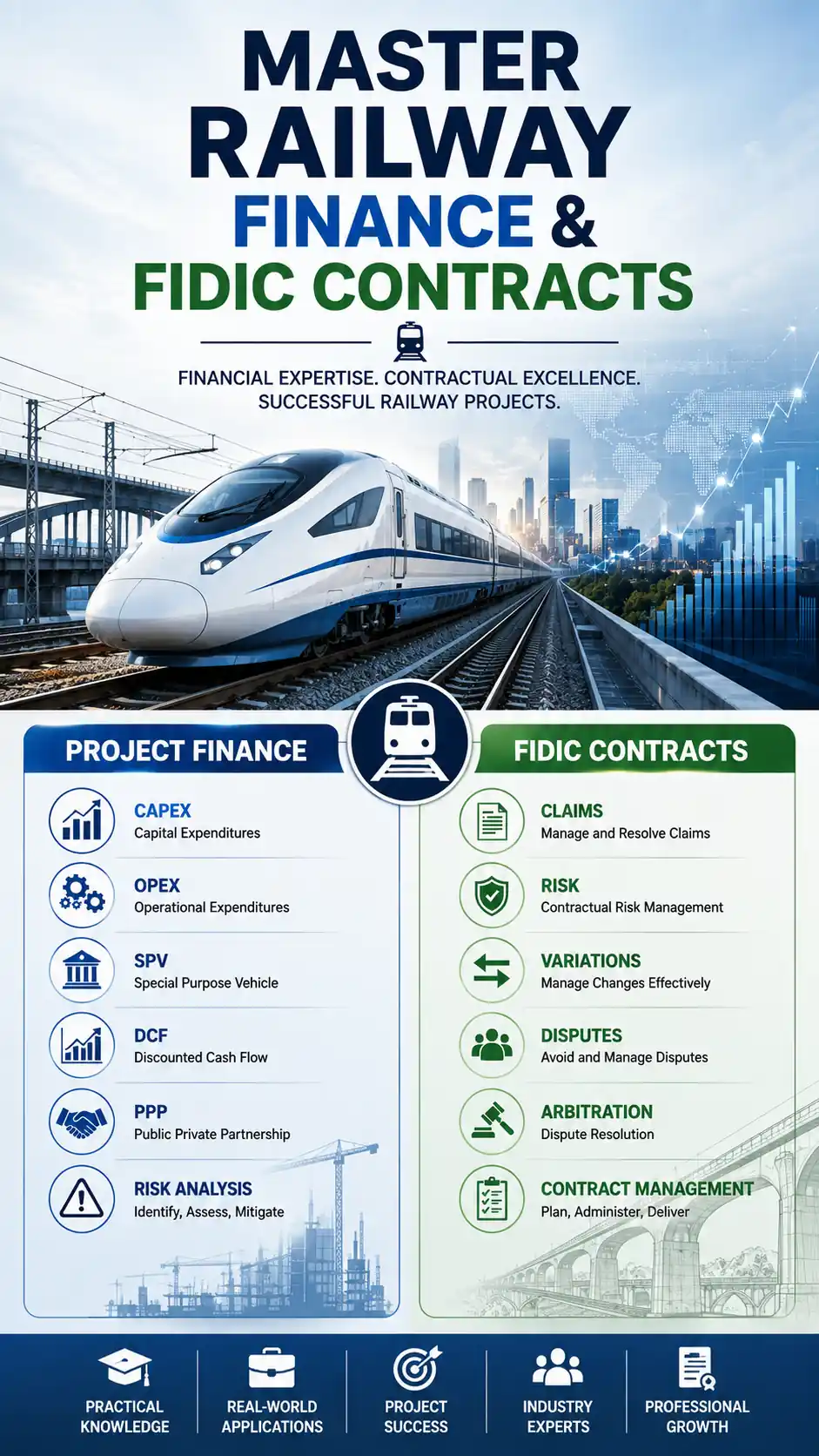
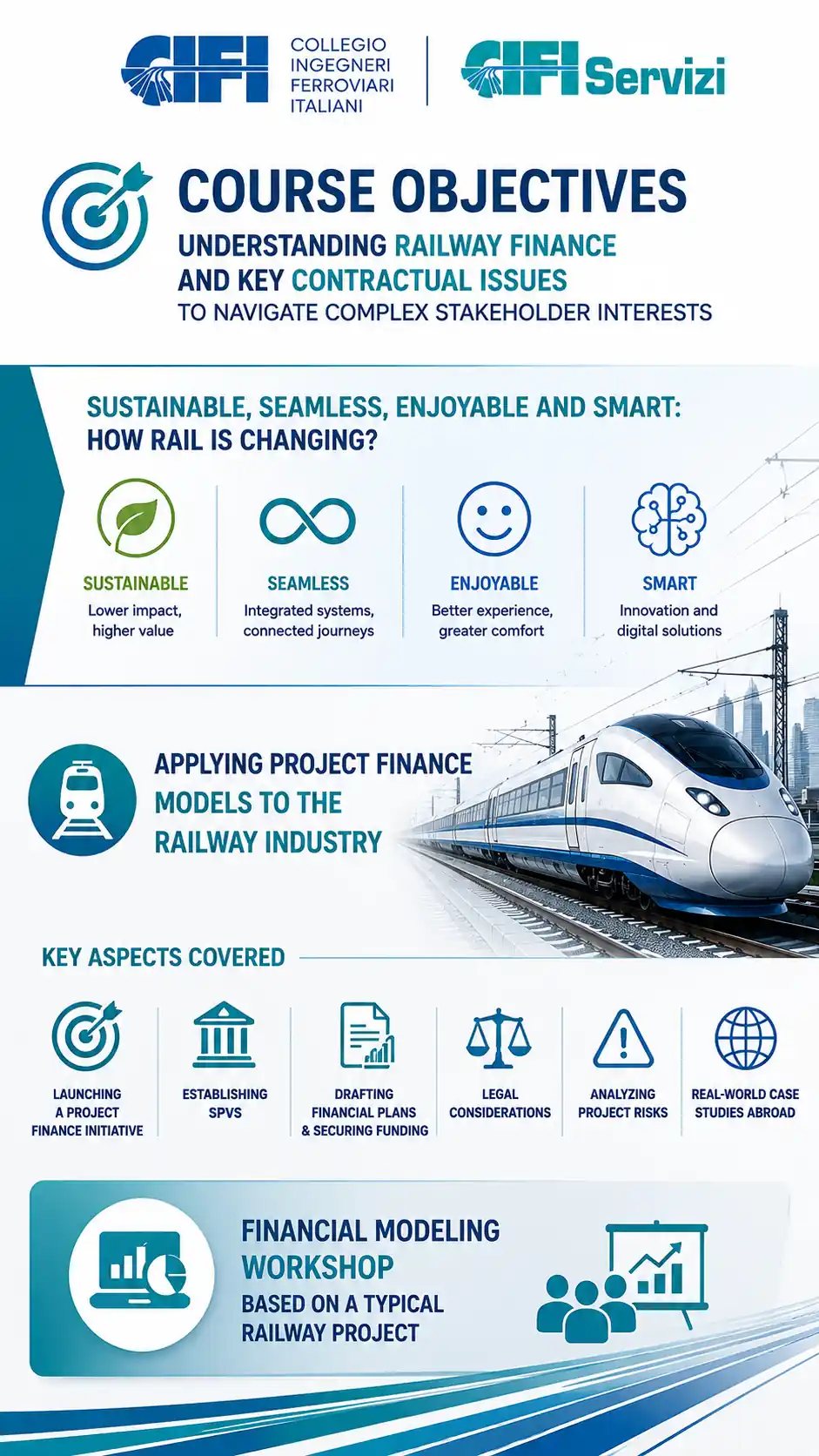
The course aims to strengthen understanding of the financial fundamentals of railway projects and key contractual issues, equipping participants with the tools to navigate the complex and often conflicting interests of the various project stakeholders.
Sustainable, Seamless, Enjoyable and Smart: How is Rail changing?
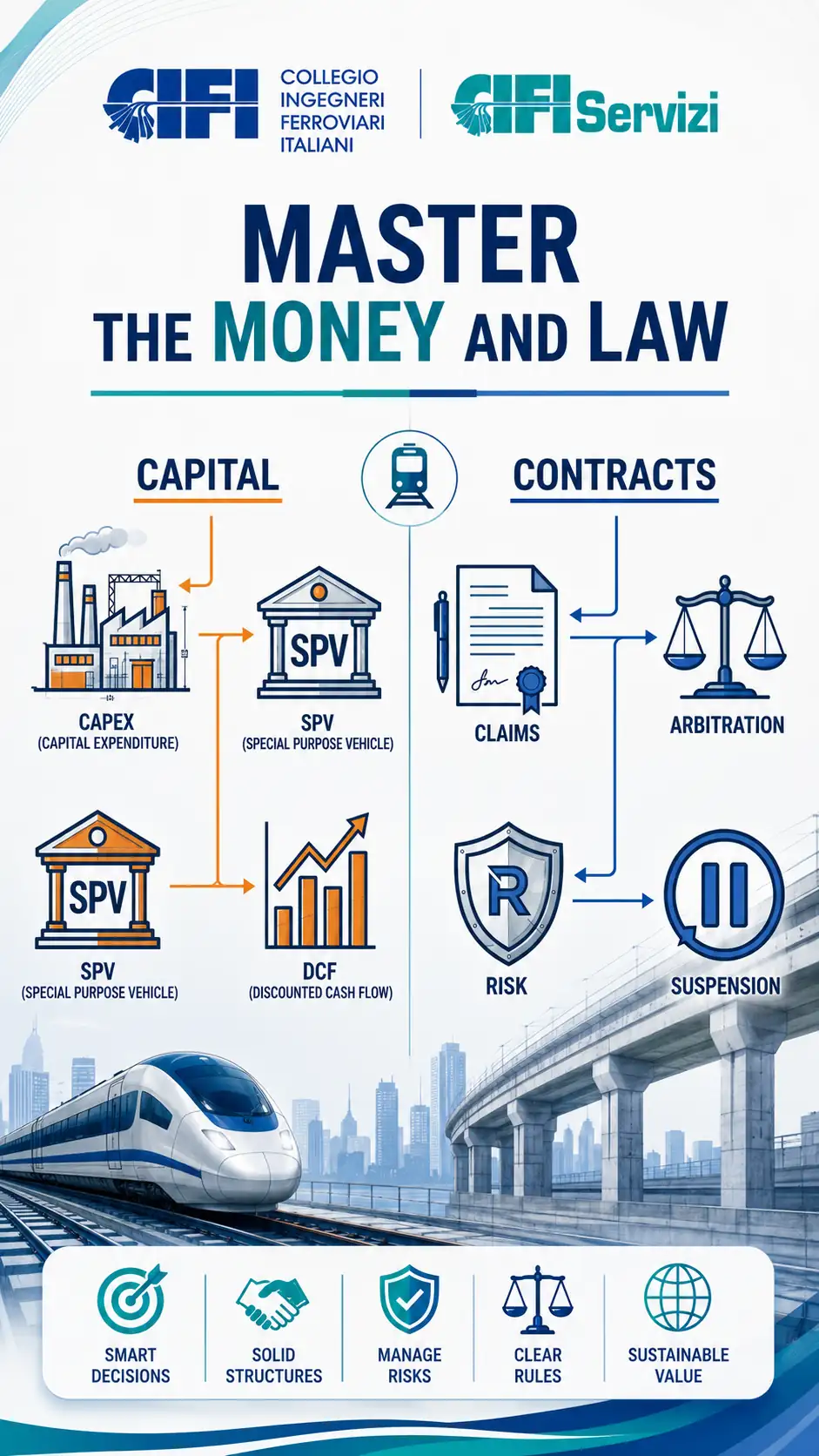
The first part of the course focuses on applying Project Finance models to the railway industry, a topic of great current relevance for public entities, national governments, and private investors seeking attractive returns. Key aspects covered include launching a project finance initiative, establishing Special Purpose Vehicles (SPVs), drafting financial plans, securing funding, addressing legal considerations, and analyzing project risks, illustrated by real-world case studies of railway construction projects abroad.
This section concludes with a financial modeling workshop based on a typical railway project.
The second part of the course addresses railway construction contract management, ranging from general contract management principles to an analysis of contract models, including an overview of international FIDIC (Fédération Internationale des Ingénieurs-Conseils) standards.
This section concludes with an analysis of Business Cases for design and construction of new railway lines. After this course you will have learned basic principles on:
- project finance and public-private partnerships for railway industry
- evaluating the feasibility of a project for a railway facility from an economic and financial perspective
- Discounted Cash Flow Analysis of New Railway Line: Capital Expenditures (CAPEX) and Operational Expenditures (OPEX)
- managing a railway contract abroad
- What FIDIC-based contracts are and how they are managed
What this course is not:
- FIDIC contract specialization course
- Project Financing specialization course

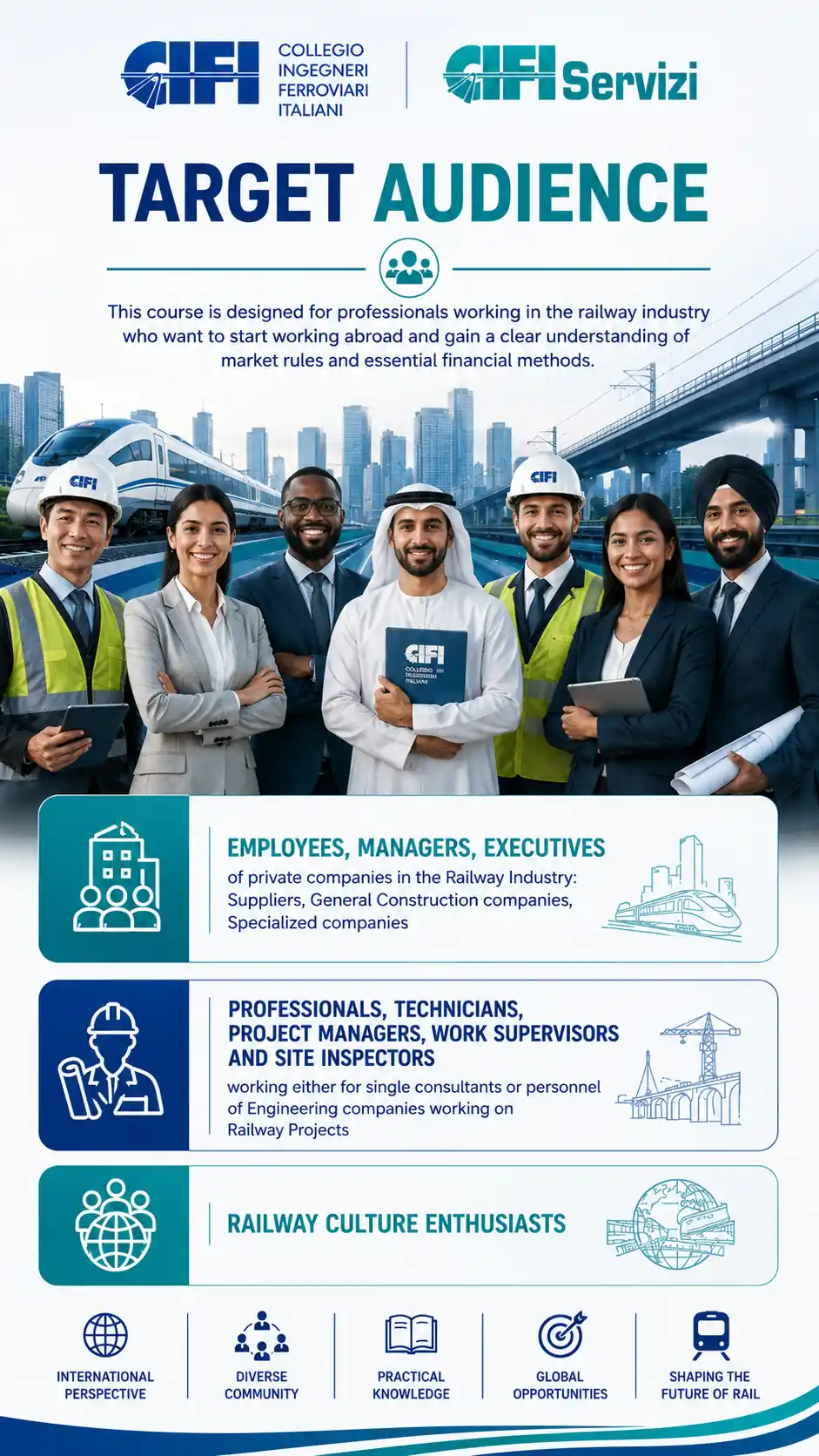
This course is designed specifically for those who work in the railway industry in their own country but want to start working abroad and wish to gain an understanding of the rules of the market and of basic financial methods.
In particular, the course is for:
- Employees, Managers, Executives of private companies of the Railway Industry: Suppliers, General Construction companies, Specialized companies;
- Professionals, Technicians, Project Managers, Work Supervisors and Site Inspectors, working either as individual consultants or as personnel of Engineering companies working on Railway Projects
- Railway culture enthusiasts
Project Financing and FIDIC Contract Management for Railway Industry – Speakers
PROF. FRANCESCA PAGLIARA is an Associate Professor of Transportation at the Department of Civil, Building and Environmental Engineering (DICEA) of the University of Naples Federico II.
She has been invited numerous times to foreign universities to give seminars and lectures, and she has also been invited four times to the European Parliament as a speaker at events promoting high-speed rail. Since 2021, she has been the promoter of the International Symposium on High-Speed Rail Socioeconomic Impacts, supported by the International Union of Railways (UIC) and she is the author of academic books in both Italian and English and of more than 200 publications.
ENG. CLAUDIO MIGLIARDI is a Manager with 30 years of experience in designing and managing civil and railway works.
He was responsible for coordinating design activities at an engineering firm – Team Engineering – specializing in infrastructure projects abroad, and he also was Project Manager and Technical Director in Impresa Percassi, Poste Italiane, Valditerra Lavori Ferroviari (COMSA Group), Gamesa Energia Italia, Italferr (FS Group), and Società Italiane per Condotte d’Acqua (FERFINA Group).
ENG. ALFONSO PELOSI is a Civil Engineer with more than 45 years of experience in the construction industry.
Over the course of his career, he has worked on major infrastructure projects in more than 25 countries, including highways, railways, bridges, viaducts, tunnels, dams and hydropower plants. He is a FIDIC Certified Adjudicator on the President’s List, a FIDIC Certified Trainer, and a member of the FIDIC Contracts Committee (TG9 – YRE), the Dispute Resolution Board Foundation (DRBF) and the Society of Construction Law (SCL).

LESSON 1.1 - HOW IS RAIL CHANGING?
Start of the course and introduction
Lesson 1.1 – How is rail changing?
[1 hour] – 25th November, 2026 [2:00 pm -3:00 pm CET Time]
Contents: Sustainable, Seamless, Enjoyable and Smart Rail
Rail transport is rapidly evolving to meet the demands of a more sustainable, connected, and digital world. Modern rail systems focus on four key pillars: sustainability, by reducing emissions through electrification and energy-efficient technologies; seamless mobility, by integrating rail with other transport modes and digital ticketing; passenger experience, by offering greater comfort, accessibility, and onboard services; and smart technologies, including artificial intelligence, IoT, and predictive maintenance to improve safety, reliability, and operational efficiency. Together, these innovations are transforming rail into a cleaner, smarter, and more attractive mode of transport, supporting the transition toward a more sustainable and efficient mobility system.
Speaker: Prof. Francesca Pagliara
LESSON 1.2 - FROM TRANSIT NODES TO LIVEABLE DISTRICTS
Lesson 1.2 – From Transit Nodes to Liveable Districts
[1 hour] – 25th November, 2026 [3:00 pm – 4:00 pm CET Time]
Contents: Evaluating 15-Minute City Principles in HSR Station
The integration of 15-minute city principles into high-speed rail (HSR) stations represents an opportunity to promote sustainable, accessible, and people-centered urban development. This approach evaluates how HSR stations can function not only as transport hubs but also as vibrant urban centers, where essential services, workplaces, public spaces, and amenities are accessible within a 15-minute walk or bike ride. By improving connectivity, mixed land use, and multimodal mobility, HSR stations can enhance quality of life, reduce car dependency, and support inclusive and resilient cities. Evaluating these principles helps guide planning strategies that maximize the social, environmental, and economic benefits of high-speed rail infrastructure.
Speaker: Prof. Francesca Pagliara
LESSON 1.3 - CONCEPTS OF PROJECT FINANCING – ECONOMIC AND FINANCIAL ANALYSIS AND METHODS. PART 1
Lesson 1.3 – Concepts of Project Financing – Economic and Financial analysis and methods. Part 1
[2 hours] – 25th November, 2026 [4:00 pm – 6:00 pm CET Time]
Contents: Financial Mathematics (simple interest, compound interest, principal, interest rate, present value (PV), future value (FV), annuity); Investments (NPV – Net Present Value, IRR – Internal Rate of Return, cut off period and payback period); Project Financing (corporate lending vs project financing, DCF analysis – Discounted Cash Flow analysis, SPV – Special Purpose Vehicle, stakeholders, life cycle of projects, debt capacity vs debt requirements, DSCR – Debt Service Cover Ratio, LLCR – Loan Life Cover Ratio)
Speaker: Eng. Claudio Migliardi
LESSON 2.1 - CONCEPTS OF PROJECT FINANCING – ECONOMIC AND FINANCIAL ANALYSIS AND METHODS. PART 2
Lesson 2.1 – Concepts of Project Financing – Economic and Financial analysis and methods. Part 2
[1 hour] – 2nd December, 2026 [2:00 pm – 3:00 pm CET Time]
Contents: Project Financing (Why Rail – Analysis of railway investment, PPP models – Public Private Partnership models); Risk Management (Risk Classification Breakdown, Risk Assessment)
Speaker: Eng. Claudio Migliardi
LESSON 2.2 - WORKSHOP ON DISCOUNTED CASH FLOW ANALYSIS OF A NEW RAILWAY LINE – DESIGN, CONSTRUCTION AND FACILITY MANAGEMENT
Lesson 2.2 – Workshop on Discounted Cash Flow Analysis of a New Railway Line – Design, Construction and Facility Management
[3 hours] – 2nd December, 2026 [3:00 pm – 6:00 pm CET]
Contents: Management; CAPEX and OPEX analysis
Speaker: Eng. Claudio Migliardi
LESSON 3.1 - FIDIC – INTRODUCTION AND CONTRACT MANAGEMENT. PART 1
Lesson 3.1 – FIDIC – Introduction and Contract Management. Part 1
[4 hours] – 9th December, 2026 [2:00 pm – 6:00 pm CET Time]
Contents: Main Responsibilities of the Parties and of the Engineer (Clause 1 – General Provisions, Clause 2 – The Employer, Clause 3 – CONS/P&DB: The Engineer, Clause 3 – EPCT: The Employer’s Administration, Clause 4 – The Contractor, Clause 5 – CONS: Subcontracting, Clause 5 – P&DB/EPCT: Design); Management and Administration of Projects (Clause 6 – Staff and Labour, Clause 7 – Plant Materials and Workmanship, Clause 8 – Commencement Delays and Suspension, Clause 10 – Employer’s Taking Over, Clause 11 – Defects After Taking Over, Tests on Completion and after Completion, Clause 9 – Tests on Completion, Clause 12 – P&DB/EPCT: Tests after Completion); Financial Clauses and Payment Procedures (Clause 12 – CONS: Measurement and Valuation, Clause 13 – Variations and Adjustments, Clause 14 – Contract Price and Payment).
Speaker: Eng. Alfonso Pelosi
LESSON 4.1 - FIDIC – CONTRACT MANAGEMENT. PART 2
Lesson 4.1 – FIDIC – Contract Management. Part 2
[1 hour] – 16th December, 2026 [2:00 pm – 3:00 pm CET Time]
Contents: Management and Administration of Project: Suspension and Termination (Clause 15 – Termination by Employer, Clause 16 – Suspension and Termination by Contractor), Risk, Liability and Exceptional Events (Clause 17 – Care of the Works and Indemnities, Clause 18 – Exceptional Events, Clause 19 – Insurance), Claims (Clause 20 – Employer’s and Contractor’s Claims), Disputes and Arbitration (Clause 21 – Disputes and Arbitration)
Speaker: Eng. Alfonso Pelosi
LESSON 4.2 - FIDIC – BUSINESS CASES
Lesson 4.2 – FIDIC – Business Cases
[2 hours] – 16th December, 2026 [3:00 pm – 5:00 pm CET Time]
Contents: design and construction of new railway lines
Speakers: Eng. Claudio Migliardi and Eng. Alfonso Pelosi
FINAL ASSESSMENT TEST FOR PARTICIPANTS
Final assessment test for participants
[1 hour] – 16th December, 2026 [5:00 pm – 6:00 pm CET Time]

webinar from your PC (only in English)

or DOWNLOAD APP ABLIOAUDIENCE

AND LISTEN IN YOUR LANGUAGE FROM PHONE
Instructions
EVENT CODE – being defined


Course purchase options
Live Videoconference and On-Demand
In other languages (with simultaneous translation by interpreters)
€2000*
15 hours of lessons
Training materials
Lessons translated into your language
Access to recorded lessons for one year after the end
Optional Final online exam
Certificate of attendance (without taking the final exam) or certificate of participation (with participation in the final exam)
Access to the video course for 12 months
In English or Italian
€1500*
15 hours of lessons
Training materials
Access to recorded lessons for one year after the end
Optional final online exam
Certificate of attendance (without taking the final exam) or certificate of participation (with participation in the final exam)
Access to the video course for 12 months
* prices excluding VAT
Companies & Jobs
Professions, projects and companies
TRAINING COURSES
Grow your railway CV
Legislation, Books & Magazines
CIFI is the main railway publisher in Italy
Sign-up form
Print the following form, fill it out, and send it together with the payment receipt to segreteria@cifiservizi.it
for more information, please read the course program or write to
Project Financing and FIDIC Contract Management for Railway Industry
Complete course program
The program, course objectives, sign-up form and other information are included in the following document


